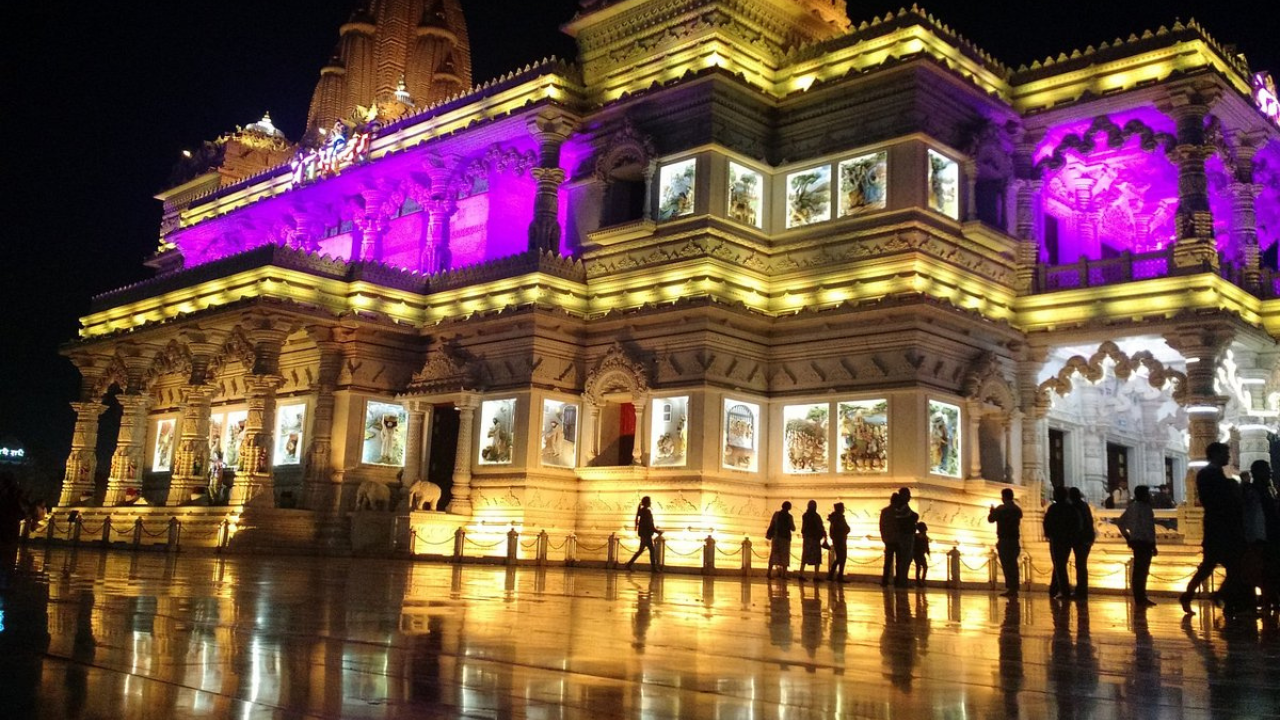
Vrindavan – The Land of Krishna’s Childhood
Mathura, nestled gracefully on the western banks of the sacred Yamuna River in Uttar Pradesh, stands as one of Hinduism’s seven holiest cities (Sapta Puri) and serves as the legendary birthplace of Lord Krishna. This ancient city, with its 5,000-year-old history woven into the very fabric of Hindu mythology, attracts millions of devotees and travelers annually who come seeking spiritual enlightenment, historical enrichment, and cultural immersion.
From the hallowed grounds of Krishna Janmabhoomi where the divine child was born to the magnificent temples that dot its landscape, from the tranquil ghats lining the Yamuna to the artistic treasures preserved in its museum, Mathura offers an extraordinary journey through time, faith, and heritage. Let me take you through the best 10 sightseeing places that capture the essence of this sacred city.
Shri Krishna Janmabhoomi Temple – The Sacred Birthplace
Shri Krishna Janmabhoomi Temple Complex represents the spiritual heart of Mathura, marking the exact location where Lord Krishna was born over 5,000 years ago in a prison cell where his parents, Devaki and Vasudeva, were imprisoned by the tyrannical King Kansa. According to the Bhagavata Purana, Krishna was born at midnight on the eighth day (Ashtami) of the dark fortnight in the month of Bhadrapada, and divine intervention miraculously opened all the prison doors, allowing Vasudeva to carry the infant Krishna across the flooded Yamuna River to safety in Gokul.
The temple’s history is as tumultuous as it is ancient – originally built by Krishna’s great-grandson Vajranabh, it was subsequently rebuilt during Emperor Chandragupta Vikramaditya’s reign in the 4th century CE, destroyed by Mahmud of Ghazni in 1017 CE, rebuilt again, demolished by Aurangzeb in 1670 CE who constructed the Shahi Eidgah Mosque adjacent to it, and finally reconstructed in the 1950s through tireless efforts led by Pandit Madan Mohan Malaviya and industrialist Ramkrishna Dalmia. Today’s complex houses the Keshavdev Temple as the main shrine, the underground Garbha Griha (birth chamber) where devotees can offer prayers at the exact birthplace, Bhagavata Bhavan with five shrines, and an informative museum displaying artifacts and artwork depicting Krishna’s life.
Entry Time Morning: 5:00 AM – 12:00 PM
Exit Time Evening session closes at 9:00 PM (4:00 PM – 9:00 PM)
Entry Fee FREE for all visitors
Duration 2-3 hours recommended for complete darshan
Location Near Deeg Gate, Mathura-Deeg Road, 3 km from Mathura Junction
Important Note Mobile phones, cameras, bags NOT allowed | Free locker facilities available
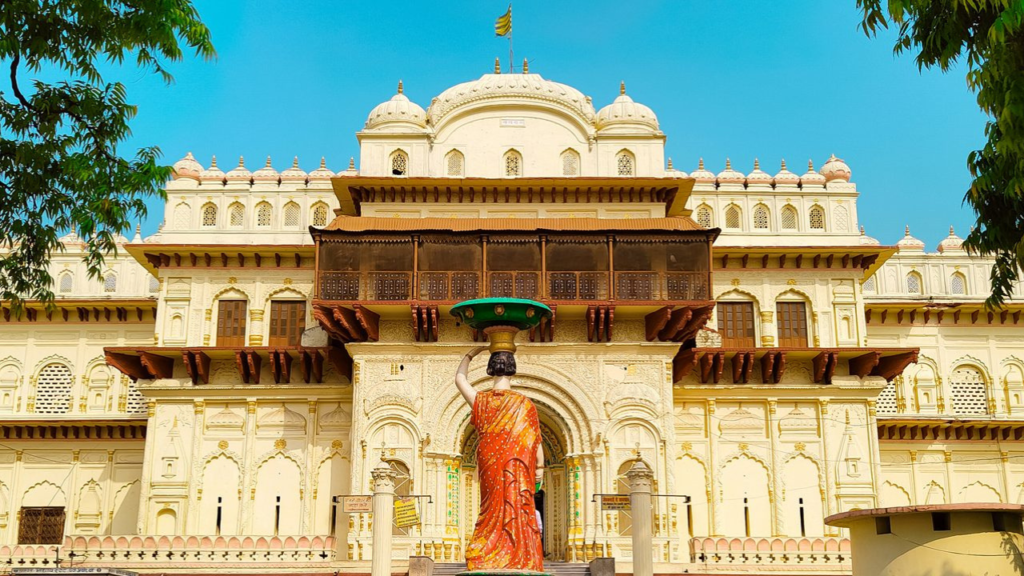
Dwarkadhish Temple – Krishna as the King of Dwarka
Dwarkadhish Temple, built in 1814 by Seth Gokul Das Parikh, the wealthy treasurer of the Gwalior Estate and devoted follower of Lord Krishna, stands as one of Mathura’s most architecturally magnificent temples dedicated to Krishna in his majestic form as Dwarkadhish – the King of Dwarka. Unlike most temples that portray Krishna as the playful child (Bal Gopal), this temple uniquely showcases him as a divine sovereign seated on a throne alongside his beloved Radha Rani, reflecting the glory of his later years when he ruled the legendary underwater city of Dwarka.
The temple’s stunning architecture represents a harmonious blend of Rajasthani and Mughal styles, featuring intricately carved jharokhas (ornate balconies), beautifully painted ceilings narrating Krishna’s entire life through vibrant frescoes, ornamental arches, and five exquisitely carved pillars that divide the temple into sections. Managed by followers of the Pushti Marg tradition established by Mahaprabhu Vallabhacharya, the temple houses a striking black marble idol of Krishna adorned daily with fresh garments and jewelry. The ceiling paintings depict various leelas (divine pastimes) of Krishna in extraordinary detail and color.
Located strategically near Vishram Ghat on the Yamuna riverfront, the temple atmosphere vibrates with devotional energy, especially during the evening Aarti when hundreds of devotees gather to offer prayers and witness the spectacular ceremonies.
Summer Timings Entry: 6:00 AM | Midday break: 1:00 PM | Re-entry: 5:00 PM | Exit: 9:30 PM
Winter Timings Entry: 6:00 AM | Midday break: 1:00 PM | Re-entry: 4:30 PM | Exit: 8:30 PM
Entry Fee FREE for all visitors
Duration 1-2 hours
Special Evening Aarti at 7:00 PM | Yamuna Aarti at nearby Vishram Ghat
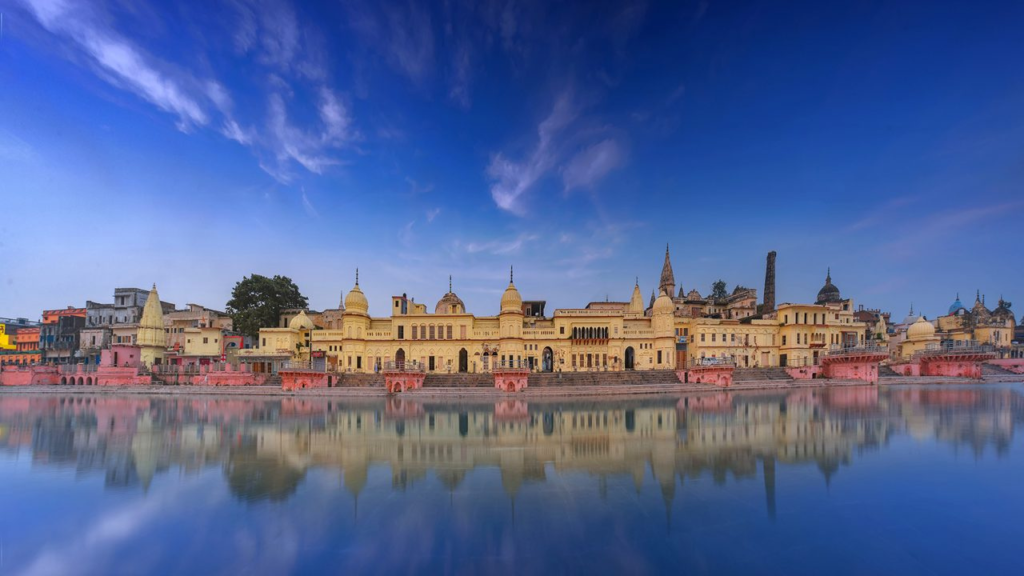
Vishram Ghat – The Sacred Resting Place
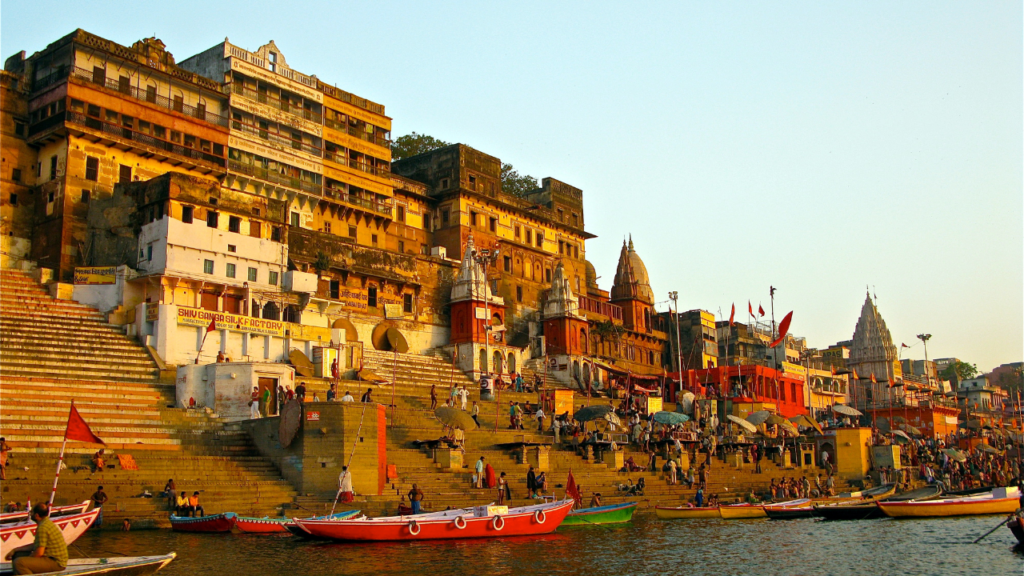
Vishram Ghat holds paramount mythological significance as the sacred spot where Lord Krishna rested (Vishram literally means ‘rest’) after defeating his tyrannical maternal uncle, the demon king Kansa, who had imprisoned Krishna’s parents and terrorized Mathura for years. According to ancient legends, after the fierce battle that freed Mathura from Kansa’s oppressive rule, Krishna came to this ghat on the banks of the holy Yamuna River and sat beneath the shade of Giriraj Ji to rest and refresh himself. This ghat serves as the geographical and spiritual center of Mathura’s 25 ghats, with 12 ghats positioned on its north side and 12 on the south, making it the epicenter of religious activity in the city.
The ghat’s recorded history dates back thousands of years, having witnessed significant historical events including conflicts during the Mughal era when Emperor Sikandar Lodi issued restrictive decrees against Hindu practices here, which were eventually removed through the dedicated efforts of Acharya Keshav Bhatt Kashmiri of the Nimbark sect and Vallabhacharya Ji Maharaj. The ghat’s architecture features beautiful marble stonework, intricate carvings, and a massive stone arch entrance that welcomes pilgrims. Lined with numerous temples including Yamuna-Krishna Temple and Murli Manohar Temple, Vishram Ghat witnesses thousands of devotees performing sacred rituals daily.
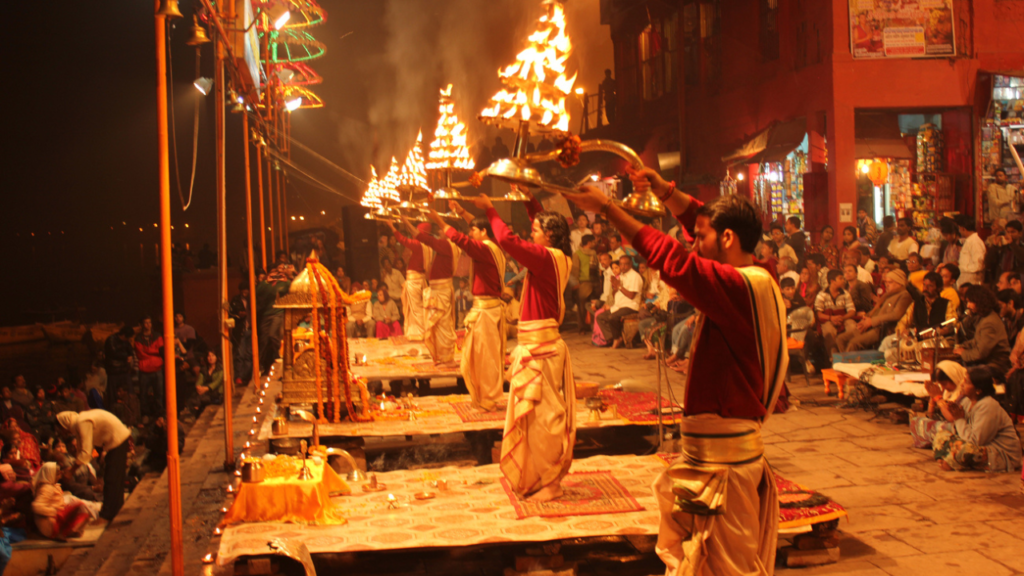
The traditional Parikrama (circumambulation of holy sites in Mathura) both begins and ends at this ghat, cementing its status as Mathura’s spiritual heart, while the spectacular morning and evening Yamuna Aartis create mesmerizing scenes with thousands of earthen lamps floating on the river.
Timings Open 24 hours daily | Best visit: Early morning or evening for Aarti
Aarti Times Morning Aarti: 6:00 AM | Evening Aarti: 7:30 PM
Entry Fee FREE
Activities Holy bath in Yamuna, Aarti participation, boat rides, Parikrama
Location Vishram Bazar, Choubey Para, 4 km from Mathura Junction
Government Museum (Mathura Museum) – Treasury of Ancient Art
The Government Museum Mathura, founded in 1874 by Sir F.S. Growse, the then Collector of Mathura district, stands as one of India’s oldest and most prestigious museums, renowned worldwide for housing the finest collection of sculptures from the celebrated Mathura School of Art that flourished between the 3rd century BC and 12th century AD. Initially known as the Curzon Museum of Archaeology, this octagonal red sandstone architectural marvel showcases extraordinary artistic heritage from the Maurya, Sunga, Kushan, and Gupta dynasties that once ruled this region.
The museum’s priceless collection includes over 6,000 stone sculptures, 25,000 ancient coins, 3,000 terracotta figurines, 350 metal artifacts, and 1,300 other artistic treasures. Among its most celebrated exhibits is the iconic headless statue of Emperor Kanishka dressed in Central Asian attire with enormous boots and a sword, the serene ‘Standing Buddha’ statue that revolutionized Buddhist iconography, archaic mother goddess figurines, intricate Jain Tirthankara images from the 1st century, ornate pottery and painted murals depicting daily life, impressive numismatic collections spanning different historical periods, and a remarkable 3,000-year-old humanlike copper figure discovered in Shahabad.
The museum also houses the statue of Queen Victoria, former Empress of India. Art historians and scholars from across the globe visit this institution to study the Mathura School’s unique contribution to Indian art, particularly its pioneering role in creating the first images of Buddha and developing distinct sculptural styles that influenced art across Asia from Taxila to Sarnath, Bodh Gaya, Sanchi, and Kaushambi.
Entry Time 10:30 AM
Exit Time 4:30 PM (Last entry at 4:00 PM)
Closed Days Mondays and all Public Holidays
Entry Fee Indians: ₹20 | Foreigners: ₹250 | Students: Discounts with valid ID
Camera Fee ₹20 additional for photography
Duration 1.5-2 hours recommended
Location Museum Road, Dampier Nagar, 2.5 km from Mathura Junction
Gita Mandir (Birla Temple) – Temple of Divine Knowledge
Gita Mandir, popularly known as Birla Mandir, represents a magnificent modern temple built in 1946 by the illustrious industrialist and philanthropist Jugal Kishore Birla of the renowned Birla family, dedicated to the cherished memory of his beloved parents. What distinguishes this temple as truly extraordinary among India’s countless shrines is that the entire sacred text of the Bhagavad Gita – all 700 verses containing Lord Krishna’s profound philosophical teachings to the warrior Arjuna on the battlefield of Kurukshetra – is inscribed in exquisite calligraphy on the temple’s marble pillars and walls, making it a living manuscript of divine wisdom.
This spiritual landmark was inaugurated by Mahatma Gandhi himself on February 25, 1946, symbolizing its significance as a place promoting universal harmony and spiritual enlightenment. Designed by renowned architect Shri Sris Chandra Chatterjee, the temple beautifully blends ancient and modern Indian architectural elements through red sandstone and white marble construction, showcasing traditional Nagara-style Hindu architecture with spacious halls, ornate domes, and a tall shikhara adorned with intricate floral and geometric carvings.
The main sanctum houses a beautiful white marble idol of Radha-Krishna in divine embrace, while additional shrines enshrine Lakshmi-Narayan and Sita-Ram. The temple complex features Krishna’s magnificent chariot, the imposing 18-meter tall Gita Stambh (victory pillar with carved Gita verses), a museum displaying historical artifacts and manuscripts, a planetarium for astronomical education, beautifully landscaped gardens perfect for meditation, and a small Hanuman temple. The marble walls throughout showcase exquisite paintings depicting various Hindu deities, gods and goddesses, and vivid scenes from epic tales, creating a comprehensive visual narrative of divine stories and spiritual teachings.
Summer Timings Entry: 5:00 AM | Midday break: 12:00 PM | Re-entry: 2:00 PM | Exit: 8:00 PM
Winter Timings Entry: 5:30 AM | Midday break: 12:00 PM | Re-entry: 2:00 PM | Exit: 8:30 PM
Aarti Times Morning Aarti: 7:00 AM | Evening Aarti: 7:00 PM
Entry Fee FREE (Donations welcome)
Duration 1.5-2 hours
Location Mathura-Vrindavan Road, 6.5 km from Mathura Junction
Kusum Sarovar – Lake of Flowers
Kusum Sarovar, whose name translates to ‘Lake of Flowers,’ stands as a breathtakingly beautiful historical reservoir located between Govardhan Hill and Radha Kund, approximately 24 kilometers from Mathura city. This sacred water body dates back to the era of Radha and Krishna and holds deep mythological significance in Braj region’s spiritual landscape. According to ancient legends, Radha would come to this serene spot surrounded by fragrant flowers – beli, chameli, juhi, yuthi, mallika, and campaka – ostensibly to collect flowers with her friends (sakhis), but secretly to meet her beloved Krishna for playful conversations and romantic interludes.
One famous story describes how Radha’s dress once got caught in thorns while she gathered flowers, and Krishna, disguised as a gardener, came to her rescue and freed her dress. The sarovar itself is an impressive 450 feet long and 60 feet deep tank with steps descending on all four sides to the emerald green waters. The site underwent significant historical developments when Raja Veer Singh Deo of Orcha restored this natural pond in 1675, and later in the mid-18th century, King Jawahar Singh of Bharatpur commissioned the magnificent red sandstone cenotaph complex to honor his father, the legendary King Suraj Mal, and his two queens – Kishori Devi and Hansiya Devi.
The architectural marvel features a central square-shaped chhatri with a lofty stone terrace adorned with corner pavilions and lateral bays, flanked by two smaller monuments on a 460-feet terrace. The interior walls display stunning paintings depicting Krishna’s divine pastimes (leelas), scenes from Raja Suraj Mal’s court, and beautiful representations of Radha-Krishna’s lotus feet carved into the floor. The complex is surrounded by beautifully manicured gardens blooming with colorful flowers, and the entire monument perfectly reflects in the calm waters of the sarovar during sunrise and sunset, creating an enchanting, almost ethereal atmosphere.
Timings Sunrise to Sunset (approximately 6:00 AM – 7:00 PM)
Entry Fee FREE
Duration 1-1.5 hours
Best Time Early morning or sunset for spectacular views and photography
Location Between Govardhan Hill and Radha Kund, 24 km from Mathura
Nearby Radha Kund (2 km), Govardhan Hill (5 km)
Radha Kund & Shyam Kund – Most Sacred Ponds of Braj
Radha Kund and Shyam Kund are two supremely sacred water reservoirs located in the Braj region, considered by Gaudiya Vaishnava tradition to be the holiest places in the entire universe due to their intimate association with Radha and Krishna’s divine love. According to the ancient Puranas and Vaishnava scriptures, Radha Kund was manifested by Radharani herself while Shyam Kund (also called Krishna Kund) was created by Lord Krishna, making these twin ponds the embodiment of divine love and devotion.
The legendary story describes how Krishna killed the demon Aristasura who had taken the form of a bull, and to purify himself from this act, Krishna created a kund with his flute by gathering water from all the holy rivers of India. Not to be outdone in devotion, Radha created her own kund with her bangles, gathering waters from all sacred lakes and ponds. Great Vaishnava saints including Chaitanya Mahaprabhu and the Six Goswamis of Vrindavan have extolled the supreme sanctity of Radha Kund, declaring that bathing in these sacred waters grants the highest spiritual merit. The kunds are surrounded by beautiful ghats (steps) leading down to the water, numerous temples dedicated to Radha-Krishna, and ashrams of various sampradayas. Thousands of devotees perform circumambulation (parikrama) around these kunds as an act of devotion, believing it purifies the soul and grants Krishna-prema (divine love).
The surrounding area features several important temples including the famous Radha-Krishna temple, and during auspicious occasions like Kartik Purnima and Radhashtami, the kunds become sites of massive congregations where hundreds of thousands of devotees gather for holy baths, prayers, and celebrations. The waters of Radha Kund are considered so sacred that many devotees collect the water to take home for worship and to sprinkle in their homes as a blessing.
Timings Open 24 hours for darshan | Best time: Early morning or evening
Entry Fee FREE
Duration 1-2 hours for parikrama and temple visits
Location Near Govardhan, 26 km from Mathura | 7 km from Kusum Sarovar
Special Days Kartik Purnima, Radhashtami – massive gatherings
Activities Holy bath, parikrama, temple darshan, meditation
Govardhan Hill – The Sacred Mountain Krishna Lifted
Govardhan Hill represents one of the most significant pilgrimage sites in the Braj region, immortalized in Hindu mythology as the sacred mountain that Lord Krishna miraculously lifted on his little finger for seven continuous days and nights to protect the residents of Vrindavan from the devastating rains sent by the angry deity Indra. This extraordinary event, known as the Govardhan Leela, occurred when young Krishna convinced the villagers to stop worshipping Indra and instead honor Govardhan Hill and their cows, leading the offended Indra to unleash torrential rains to flood Vrindavan.
Krishna responded by effortlessly lifting the entire Govardhan Hill like an umbrella, providing shelter to all the villagers, their cattle, and belongings underneath for seven days until Indra accepted defeat and begged for forgiveness. Govardhan Hill stretches approximately 8 kilometers in length and today stands only about 80 feet high, though ancient texts describe it as significantly taller in earlier times. The hill is dotted with numerous sacred sites including Manasi Ganga (a lake created by Krishna’s will), Kusum Sarovar, Radha Kund, and countless temples. Devotees perform Govardhan Parikrama – a sacred 21-kilometer circumambulation around the entire hill – which is considered highly meritorious and typically takes 4-5 hours to complete on foot.
The tradition of Govardhan Puja, celebrated one day after Diwali during the festival of Annakut (mountain of food), witnesses elaborate celebrations where devotees create massive arrangements of vegetarian food items shaped like mountains and offer them to the deity. The hill itself is worshipped as a manifestation of Krishna, and devotees believe that even the stones and dust from Govardhan possess divine qualities and offer them in worship with great reverence and devotion.
Timings Open 24 hours for parikrama | Temples: Generally 5:00 AM – 9:00 PM
Entry Fee FREE (no entry fee for hill or parikrama)
Parikrama 21 km circumambulation | 4-5 hours on foot | Can be done by vehicle also
Duration Half day for parikrama | Full day to explore all sacred sites
Location 22 km from Mathura | Well-connected by road
Best Time Early morning start for parikrama | Govardhan Puja (Oct-Nov)
Kans Qila (Kansa’s Fort) – Ancient Ruins of History
Kans Qila, the ancient fort believed to have been the palace and stronghold of the tyrannical King Kansa, stands today as evocative ruins that whisper tales of Krishna’s heroic exploits and Mathura’s ancient past. According to Hindu mythology and the Bhagavata Purana, this fortress served as the seat of power for Kansa, who imprisoned his sister Devaki and her husband Vasudeva after a divine prophecy warned that their eighth son would kill him. The fort witnessed the dramatic events that shaped Krishna’s legend – from his miraculous birth in the prison cell, his secret escape to Gokul, to his eventual return as a young man to fulfill the prophecy by slaying Kansa in a wrestling arena and liberating Mathura from tyranny.
While much of the original structure has crumbled over millennia due to natural decay, invasions, and the passage of time, the remaining stone walls, dilapidated ramparts, and archaeological remnants still evoke the grandeur and strategic importance this fortification once held. The site provides tangible connections to Krishna’s legends, allowing visitors to stand where history and mythology converge. Archaeological excavations have uncovered artifacts from various periods including pottery, coins, and structural remains that indicate continuous habitation and strategic military importance through different eras. The fort’s location on elevated ground offered tactical advantages for defense and surveillance of the surrounding region. Though now largely in ruins, Kans Qila attracts history enthusiasts, pilgrims, and archaeologists interested in exploring Mathura’s ancient past.
The quiet, somewhat isolated nature of the ruins provides a contemplative atmosphere where visitors can imagine the dramatic confrontation between the young Krishna and his demonic uncle, the event that marked the beginning of dharma’s triumph over adharma in Mathura.
Timings Generally accessible during daylight hours (6:00 AM – 6:00 PM)
Entry Fee FREE
Duration 45 minutes – 1 hour
Location Old Mathura city area, near Yamuna River bank
Best For History enthusiasts, photography, archaeological interest
Condition Ancient ruins – watch your step, wear comfortable shoes
Potara Kund – The Sacred Stepwell of Baby Krishna
Potara Kund stands as an ancient and sacred stepwell steeped in religious lore and Krishna’s childhood mythology, believed to be the very spot where Mother Yashoda and the gopis (cowherd women) of Gokul washed baby Krishna’s clothes and swaddling clothes after his secret arrival from Mathura. According to beloved legends, after Vasudeva carried newborn Krishna across the flooded Yamuna to Gokul and exchanged him with Yashoda’s baby girl, Yashoda lovingly bathed little Krishna and washed his garments at this kund, making it eternally sacred. The word ‘Potara’ refers to the bundle of clothes, hence ‘Potara Kund’ literally means ‘the pool where clothes were washed.’ This historic stepwell reflects Mathura’s architectural heritage with its intricate design featuring stone steps that descend systematically to the water level, creating a beautiful geometric pattern typical of ancient Indian water management systems.
The kund is surrounded by small shrines and temples dedicated to various forms of Krishna and Radha, their walls adorned with paintings depicting scenes from Krishna’s life. The architectural details showcase fine craftsmanship with carved pillars, ornamental niches, and traditional Indian stepwell design that served both practical purposes (water collection and storage) and religious functions (ritual bathing). Devotees visit Potara Kund to perform sacred ablutions, offer prayers, and connect with Krishna’s childhood pastimes. The peaceful atmosphere and historical ambiance make it an ideal spot for meditation and spiritual contemplation.
The stepwell represents the deep devotion and maternal love of Yashoda for Krishna, embodying the tender human emotions within divine stories. Though smaller and less frequented than major temples, Potara Kund offers history enthusiasts and sincere devotees an intimate glimpse into the daily life aspects of Krishna’s legend, showing how even mundane activities like washing clothes became sanctified through association with the divine child.
Timings Generally accessible during daylight hours (6:00 AM – 7:00 PM)
Entry Fee FREE
Duration 30-45 minutes
Location Old Mathura area, accessible by local transport
Caution Stone steps can be uneven and slippery – watch your step
Best For Quiet contemplation, historical exploration, photography.
Feel the devotion in the city of 5,000 temples.
- Trip Info: Destination: Vrindavan | Guide: One Person | Language: Hindi, English
- Trip Type: Outstation Taxi Booking
- Free Cancellation: Yes
Key Attractions
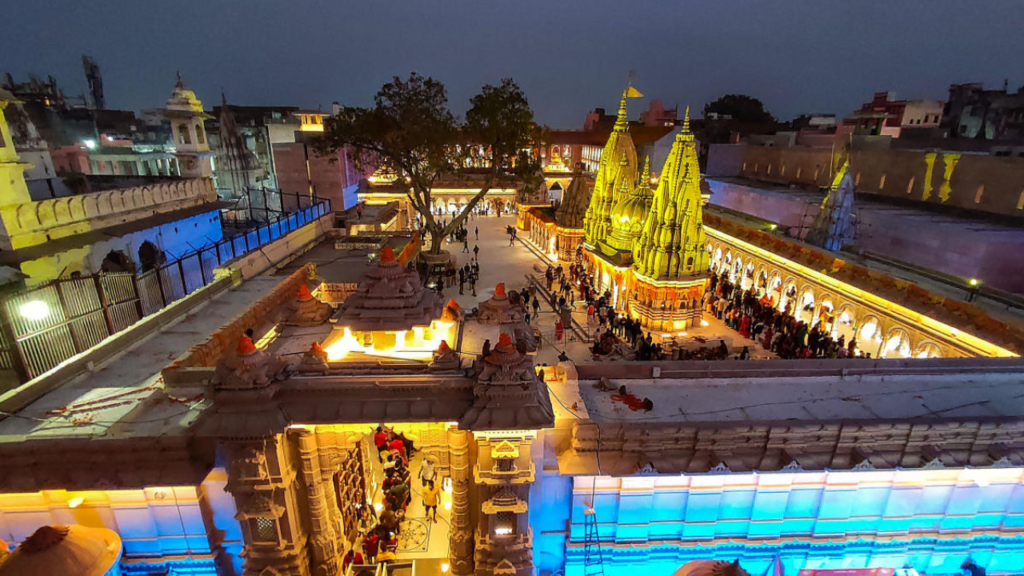
- Kashi Vishwanath Temple